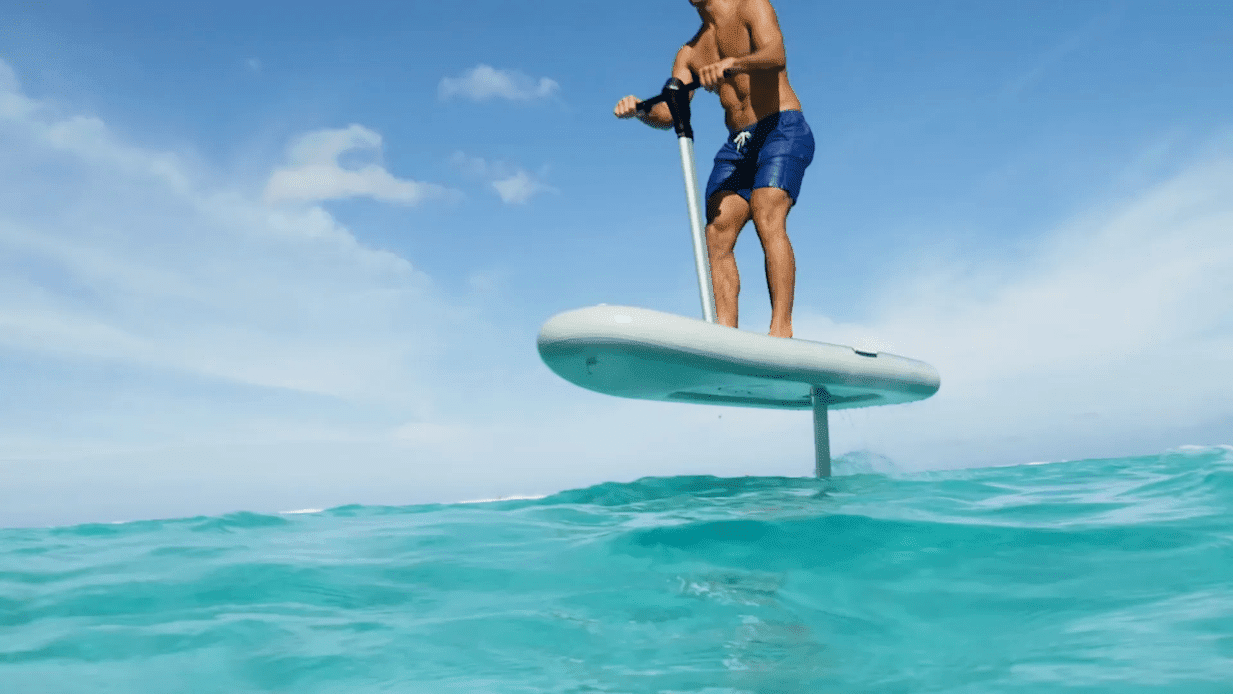
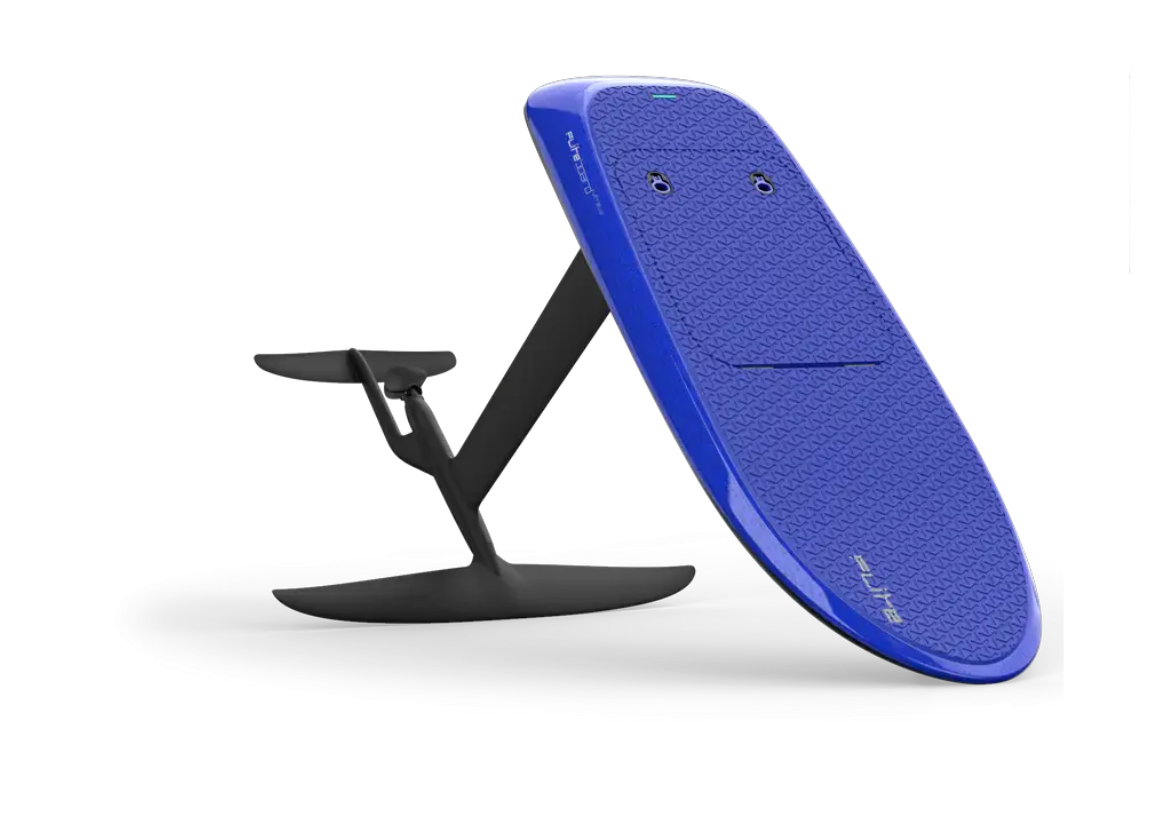
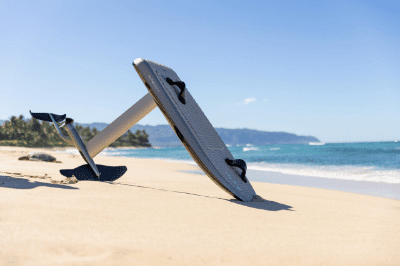
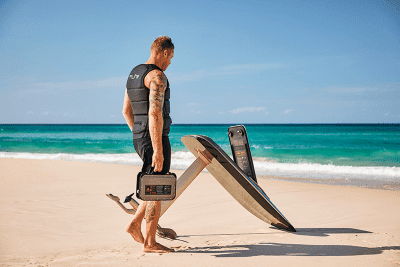
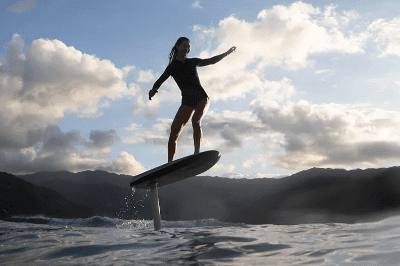
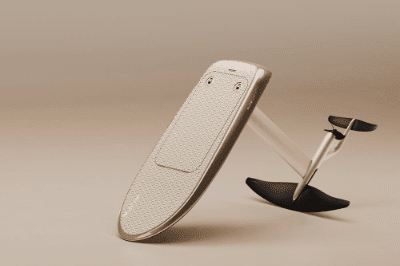
For most riders between about 200 and 265 pounds, the Fliteboard setup we point to is the 100-liter ICON hard board with the Prop C eFoil and a larger front wing. Fliteboard rates the ICON to 120 kg (265 lb), the prop gives a heavier rider steadier low-end pull than the Jet 2, and a bigger wing keeps the board calm under power while you learn where your weight needs to sit. Before buying, confirm the exact board, propulsion and wing combination with Hamish; a board's maximum rating is not a universal setup recommendation. Pound figures are rounded: use the manufacturer's kilogram limit near a ceiling.
In his Series 6 walkthrough, Hamish described teaching on the ICON at Lake Powell, and he counts himself among the heavier riders who feel the difference between the two propulsion systems. Confirm which boards and propulsion systems are available for your lesson. The quickest way to find out whether this setup fits your body is to ride it before you pay for it.
If you're still comparing the full Series 6 lineup, our Fliteboard 2026 buyer's guide covers every board side by side.
Which Fliteboard boards can you ride if you're over 220 pounds?
Fliteboard splits its boards into two weight groups. The ICON, PRO, AIR ICON, AIR PRO and Flitescooter are rated to 120 kg (265 lb). The RACE and the ULTRA L3 stop at 100 kg (220 lb). Those limits come from Fliteboard's Product Weights & Measurements sheet, last updated in July 2026. See Fliteboard’s board weights and rider limits.
The RACE is the board that catches people out. It's longer than the L3 and carries more volume (58 liters against 49), and when Hamish first walked us through the Series 6 catalog, before he'd ridden it, he expected that length to make it easier "particularly for larger riders." Leigh Digel from Chagrin Falls, Ohio, felt the same thing when he moved from his PRO to a RACE at Lake Powell: more confidence on takeoff from the extra length fore and aft. Length helps. The rating still caps the RACE at 220, so above that weight it's off the list however stable it feels.
Why does Hamish put heavier riders on the prop instead of the Jet 2?
It comes down to how each system delivers power at low speed, which is where a heavier rider works hardest. In a planning call with our team in December 2025, Hamish described riding the Jet as one of the "heavier riders, like me." You have to "gear up a lot to kind of get it to go on plane," he said, and "when it suddenly catches on, it kind of surges, and then you gear down to get it to settle in." The prop, in his words, is "just very nice, linear power, very predictable."
His own cut-off sits around 220 pounds. Above that, he said, "I wouldn't even consider it yet."
Fliteboard's propulsion notes point the same way. The brand says Flite Jet 2 draws more power than its propeller systems, and that riders should expect reduced efficiency and thrust compared with the Flite Prop. That lines up with what Hamish feels on takeoff, when there's the most load on the board and the least speed under it.
None of this makes the Jet a bad system. Hamish is clear that it's quieter, safer because the impeller is shielded, and has "plenty of power." It also carries less drag when you ride unpowered. The trade-off is how the power arrives, and a heavier rider notices that most in the first few seconds of every takeoff.
What if you already own a Jet 2 and takeoffs feel slow?
Check your software first. In May 2026 Hamish was reminding Jet owners to install the latest Flite software, since Fliteboard has released updates aimed at the Jet's latency.
He has also pointed riders who find the Jet "a little laggy, especially on takeoff" toward the RACE impeller, the Mercury Racing-designed part that fits Jet C and MN Carbon Jet C systems (not the original Flite Jet). Fliteboard designs it for top-end speed, so treat it as something to talk through for your weight rather than a guaranteed fix for low-end pull.
Cruiser-family front wing. Confirm the size and compatibility for your setup with Hamish.
Start with a larger front wing. Fliteboard's own guidance is that bigger wings bring more lift and stability and suit beginners and heavier riders, while smaller wings are faster and turn tighter.
The motor supplies thrust and the wing generates lift, so a heavier rider needs a wing that provides enough lift and stability at an appropriate speed. A larger wing holds a steadier line at moderate speed and forgives small shifts in weight. A smaller wing carves harder and asks for more precise footwork. Fliteboard lists its Cruiser range as the most popular place for beginners to start.
The wing is also the cheapest part of the setup to change later. Hamish's advice to riders who feel they've plateaued is to swap wings before replacing the board, because a new wing "will dramatically change the way that the board behaves." For a heavier rider, that's a way to keep progressing on the same ICON.
Some will, though usually later than lighter riders, and the next step is narrower. In that Series 6 walkthrough, Hamish described teaching on the ICON and selling more PROs than other boards, because some students start to find the ICON large as their skills improve. With more experience, he's said, "you could probably get a little tired of it."
Among the hard boards discussed here, the PRO is the progression option above 220 pounds, at 67 liters and rated to 120 kg (about 265 lb). The RACE and L3 are off the table. Going from 100 liters to 67 is a big change in how much the board holds you up before it's flying, so read our Fliteboard PRO 2026 review before you plan on that move.
How often you'll ride should decide it. Hamish's rule of thumb when he builds a quote: if you're only riding a couple of times a year, start with something less aggressive, and if you've got regular access to water, you'll build skill faster and can go a step more aggressive. A heavier rider who gets out a few weekends a year is well served by the ICON for a long time. One who rides most mornings off a dock may want to plan toward the PRO, using wing changes to bridge the gap.
This setup isn't the right fit if powered-off wave riding is your main goal. The board built for that is the ULTRA L3, and it's rated to 220 lb.
Can I take an eFoil lesson at Lake Powell if I'm over 200 pounds?
If you're a first-time rider over 200 pounds planning a 30A or Panama City Beach vacation, yes, as long as you're at or under 245 pounds. That's the limit on our lessons page, along with a minimum age of 14.
We teach on Lake Powell, a protected coastal dune lake at Inlet Beach where Hamish chooses suitable conditions for each session. Flat water matters more for a heavier beginner, because every takeoff starts from a slow, heavily loaded board, and chop interrupts that moment. The Gulf side is a different ride, and one to save for after you've got the basics.
A few things change with weight. From December to April we recommend a 3/2 wetsuit, which adds a little to what you bring to the board. Learners touch the water far more than experienced riders, which uses more battery, so Hamish runs the larger Explore battery in our school. And Fliteboard's own learning guide notes that a heavier rider lying on one of the smaller boards may sink it, so the nose has to stay out of the water to keep the controller connected.
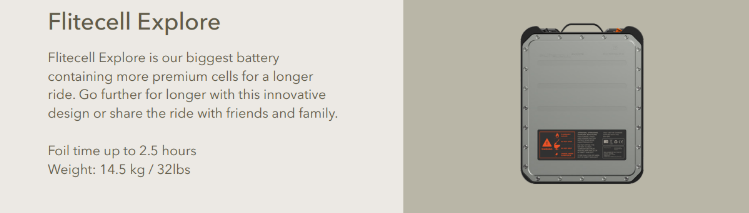
Flitecell Explore battery, discussed here for lesson-board runtime. Battery choice depends on board compatibility.
Before your lesson, Hamish gets in touch to ask what you want out of it. "When anyone books a lesson, I always reach out to them, ask them what their goals are," he told us. If you're there to work out what to buy, say so. A lesson can include time on more than one board: John Moser, who drove down from Birmingham, rode a standard Fliteboard and a PRO in the same lesson to feel the difference.
Session details and booking are on our eFoil lessons at Lake Powell page. If you're between 245 and 265 pounds, call before you book.
Every lesson includes a helmet with a two-way radio intercom and a USCG-approved life jacket, and reviewers regularly mention Hamish coaching them by radio with a drone overhead.
Should a heavier grandparent on 30A buy a Jet or prop Fliteboard for the grandkids?
If you're a grandparent over 200 pounds buying one Fliteboard for yourself and the grandkids to share on 30A, you're buying for two riders who want different things from the propulsion.
The kids' side is about safety. Hamish has sold quite a few Jets in this situation. "If you're a granddad... you don't want to be the one responsible for them losing their fingers on a prop," he said, and for that buyer the Jet "is kind of a no brainer." He's also said he's never heard of a prop incident on a Fliteboard, because the prop is set back and a rider is more likely to be hit by the wing or mast. That remains a safety concern to discuss alongside instruction, supervision and the manufacturer's safe-riding guidance.
Your side is the low end. At your weight, the Jet is the system that asks you to gear up, catch the surge and gear back down, while lighter riders may notice those takeoff differences less.
Where you ride adds to the decision. A lot of 30A families launch off a dock or ride from a boat, where a hard board can ding a dock or a boat's gel coat, and that pushes some buyers toward the AIR or a Soft Top 2 board alongside the propulsion question. Florida sun and saltwater are hard on everything too, and Hamish has said he's still watching how the newer soft-top material holds up over a few years of UV and salt.
Flite AIR: an inflatable-board option to discuss when docks, boats and shared use influence the choice.
In practice it often comes down to who logs the hours. If the grandkids will ride most, the Jet's shielded impeller usually wins and you accept a surgier takeoff. If you're the main rider and the kids ride occasionally with you watching, the prop's steadier pull may matter more. Riding both before deciding settles it faster than any spec sheet.
This is the conversation Hamish has before he quotes. When a retired veteran with grandkids emailed asking for a quote on an ICON Soft Top, Hamish's first step was finding out who would be riding it.
Frequently asked questions
Is the Flite AIR ICON a good choice for a heavy rider?
It has more volume than any hard Series 6 board, at 110 liters, and Fliteboard rates it to 265 lb. Hamish still finds the AIR harder to ride than a hard board, because its grippier surface hesitates every time it touches the water, and it's less efficient on the battery. The AIR ICON also can't take the full-size Explore battery. Our Flite AIR vs AIR PRO comparison covers where the inflatables make sense.
Does rider weight shorten Flitecell ride time?
Yes. Fliteboard rates the Nano at up to 45 minutes, and Hamish gets about 35 minutes out of one "at my weight and height." Riding style and conditions move it too, and learners burn through battery faster because they touch the water more. Our Flitecell Nano vs Sport vs Explore guide explains rated foil time versus real session time.
What if I weigh more than 245 pounds?
Our lessons cap at 245 pounds. Fliteboard rates the ICON, PRO, AIR ICON, AIR PRO and Flitescooter to 265 lb (120 kg), and no current Fliteboard is rated above that. If you're between 245 and 265, contact Hamish before booking or buying so he can talk through what's realistic at your weight.
Is the Flitescooter a good option for a heavier beginner?
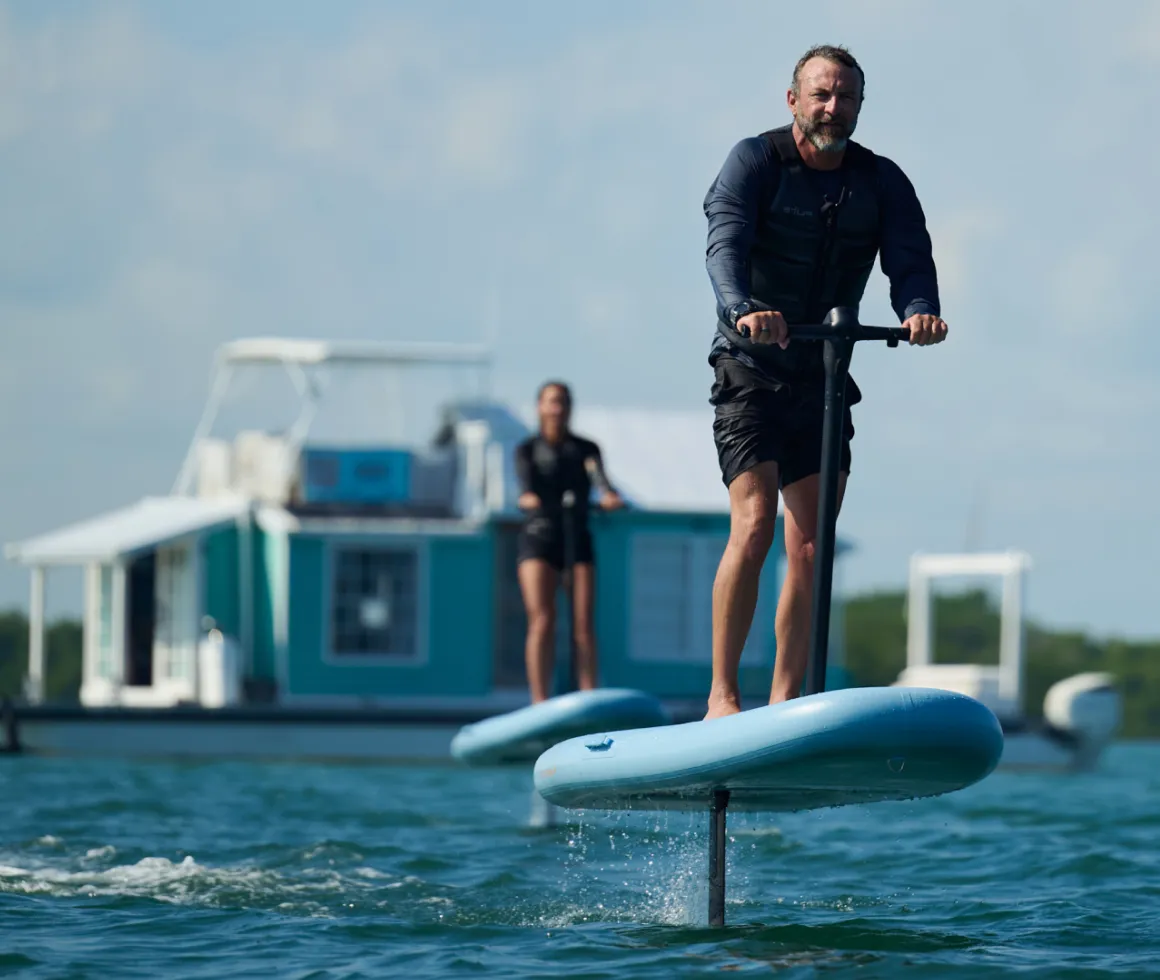
It's the largest board Fliteboard makes, at 237 liters, and it's rated to 265 lb like the ICON. The handlebars let you start standing instead of lying down and getting up at speed, and Hamish thinks it's underrated for how much fun it is. It runs a slightly shorter version of the Jet, so a heavier rider should try the takeoff before committing. Our Flitescooter guide covers who it suits.
How can a heavier rider try this setup before buying it?
Ride it at Lake Powell. A lesson lets you try equipment matched to your experience and weight, with Hamish coaching by radio. Confirm the boards available when booking, and tell him if you are shopping so he can help you compare suitable setups.