FLUX Wing Lineup Guide: Which Wing Makes Sense for Emerald Coast Riders in 2026?
By Ryan Goloversic posted on July 6, 2026
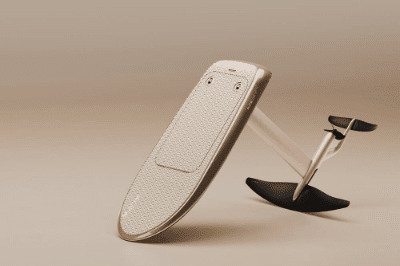
The FliteLab FLUX wings are new for 2026, and they bring a surf-foil character to the Fliteboard lineup that the standard wings were never designed for. Paired with a Series 5/6 eFoil setup, a FLUX wing changes how your board carves, how fast it runs, and how it feels when you ease off the throttle on a rolling Gulf swell.
But the FLUX is not one wing. It is a front wing and a stabilizer, each offered in three sizes, and the combination you choose decides how the whole setup rides. Get it right and the board feels tuned to you and the water you ride. Get it wrong and you are fighting a wing that was built for conditions you rarely see.
For Emerald Coast riders, that matters. Gulf conditions are not overhead surf. Most days run flat to knee-high, with wind chop around Destin and Panama City Beach and glassy water on the protected inlets near 30A. The FLUX range was built with surf performance in mind, so the size that suits a head-high reef break is not the size that suits your average day here.
This guide covers the three front wing sizes (707, 808, 1010) and the three stabilizer options (125, 140, 160) that Emerald Wake stocks, and how to match them to your weight, your skill level, and the eFoil you already ride. If you are still choosing a board before building out a wing setup, start with the Fliteboard 2026 Buyers Guide. If you are not yet sure the FLUX is the right family for you versus a Cruiser, Flow, or Wave, our guide to which Fliteboard wing is right for you compares the full lineup. If your eFoil is sorted and you want the right FLUX combination, read on.
What makes the FLUX wing different from other Fliteboard wings?
Most wings in the standard Fliteboard range were designed for eFoil riding the way most people do it: get up, cruise, carve gentle turns, and enjoy a stable, predictable ride. They are tuned for ease and forgiveness. The FLUX wings come from a different place.
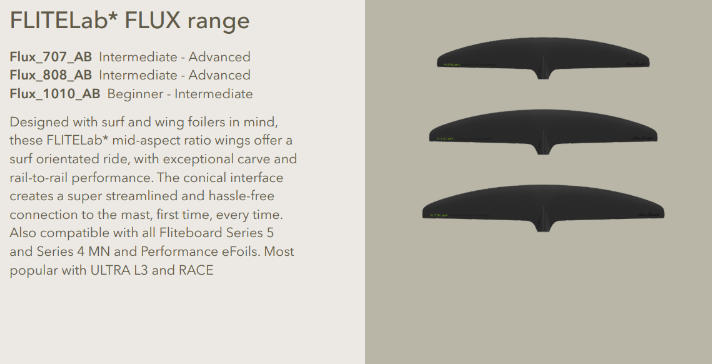
FliteLab built the FLUX as a mid-aspect ratio wing for surf foiling. The design carries Adam Bennetts' signature (the "AB" on each size), a professional surfer and foiler who rode FLUX prototypes for over nine months before launch. The wings are shaped around how he rides: tight, surf-style turns, hard carving, and a lively, responsive feel. That surf character is the whole point of the wing, and it is what you are buying when you put one on your eFoil. If you are new to what aspect ratio actually changes, our explainer on high aspect vs medium aspect wings covers the trade-offs.
On a powered setup, that translates into a few specific things. The FLUX carves tighter and rolls rail-to-rail more readily than the standard cruising wings. It holds a cleaner line at speed. And when you back off the throttle to ride a bump or a piece of swell, it behaves like a surf foil rather than an eFoil wing, which is exactly what riders chasing that feel are after.
The construction supports it. FLUX wings are high modulus carbon throughout, light and stiff, and they connect through a titanium conical interface that locks to the fuselage with two bolts and almost no play. A loose or flexing connection dulls feedback through a turn. The FLUX connection is solid, so what the wing is doing comes straight through to your feet.
One thing worth being clear about: the motor changes who can ride these. On a prone setup, a mid-aspect surf wing is an advanced tool because you have to generate your own speed to keep it flying. On an eFoil, the motor handles that, which makes the FLUX far more accessible than it would be unpowered. That said, these are still performance wings. They reward riders who already have clean throttle and board control and want a more dynamic ride. If you are still in your first hours on an eFoil, the standard wings will serve you better while you build control. The Soft Top vs Carbon eFoil guide covers where the standard setup fits for newer riders.
What are the three FLUX wing sizes and what does each one do?
The three sizes, 707, 808, and 1010, share the same mid-aspect ratio and the same carbon construction. What changes is surface area, and on an eFoil that mostly affects four things: how the wing carves, how fast it runs, how stable and forgiving it feels under power, and how it behaves when you ease off the throttle to ride swell.
Because the motor handles getting you up and keeping you lit, you are not choosing a size based on how easy it is to pump or generate speed. You are choosing based on how you want the board to feel once you are riding, and how much surf-style responsiveness you want versus how much stability.
FLUX 1010 AB: the most stable and forgiving
The 1010 is the largest size and the most planted of the three on a powered setup. It generates the most lift at lower speeds, which makes for a steady, predictable ride that is easy to trust. It still carves, but it does so on a wider arc than the smaller wings.
On an eFoil, this is the size for riders who want surf-foil character without giving up much stability. It suits heavier riders who want more lift under them, and riders who like a calm, controlled feel rather than a twitchy one. When you ride small Gulf chop or roll off the throttle on a soft swell, the 1010 stays composed.
Who it is for: heavier riders, anyone who wants the most forgiving FLUX option, and riders moving onto a FLUX wing for the first time who want an easier transition from the standard wings.
Who should look elsewhere: lighter, advanced riders who want the tightest, liveliest turns the FLUX line can deliver.
FLUX 808 AB: the all-rounder
The 808 is the middle size and the one that makes sense for the widest range of riders. It carves more readily than the 1010 and holds more stability than the 707, which puts it in the sweet spot for most Emerald Coast eFoilers.
It handles the flat-to-choppy days that make up most Gulf sessions, rewards you when a clean swell shows up, and gives intermediate riders room to push into more aggressive riding as their skills grow. Most riders who try all three end up treating the 808 as their primary wing.
Who it is for: intermediate to advanced riders across a wide weight range, and anyone who wants one FLUX wing that does a bit of everything on the Gulf.
Who should look elsewhere: pure beginners who would be better off on a standard wing for now, and advanced riders specifically chasing the sharpest possible carve.
FLUX 707 AB: the performance carver
The 707 is the smallest size and the most responsive. It turns on a dime, rolls rail-to-rail the quickest, and delivers the most surf-like feel of the three. It is Adam Bennetts' personal choice in real surf, and on an eFoil it gives advanced riders the tightest, liveliest ride in the FLUX range.
On a prone setup the 707 demands speed you have to generate yourself, which makes it an expert-only wing. The motor removes that barrier, so an intermediate-to-advanced eFoiler can ride it. But it is still the least forgiving FLUX wing. It rewards clean technique and punishes sloppy input, and it is at its best when you have the skill to ride swell unpowered and carve hard.
Who it is for: lighter and advanced riders who want maximum responsiveness, and riders who back off the throttle to surf swell whenever they can.
Who should look elsewhere: heavier riders who want more lift and stability, and anyone still working on smooth board control, who will find the 808 or 1010 more rewarding.
All three sizes are available on the FLUX front wing product page, where you can see current pricing and pick the variant once you have settled on a size.
Which FLUX wing fits Gulf of Mexico conditions?
Most wing guides explain the three sizes in a vacuum, as if every buyer rides the same water. They do not. The right FLUX wing for someone foiling head-high reef breaks is not the right wing for someone riding a Fliteboard on the Gulf, and the difference is worth getting right before you spend a thousand dollars.
The Emerald Coast has its own profile. Most days run flat to knee-high. The protected inlets and bays near 30A are often glassy. When wind picks up around Destin and Panama City Beach, you get rolling, wind-driven chop rather than clean, organized swell. Real head-high surf does happen, but it is the exception, and it usually arrives with a storm rather than a normal riding day.
On an eFoil, the motor means you are never stuck waiting for a wave to get going. So the Gulf question is not about whether a wing can generate enough lift on flat water. It is about how the wing feels once you are up: how it carves on glassy inlets, how it handles chop without getting skittish, and how it behaves the moment you ease off the throttle to ride a soft swell.
For most local riders, that points to the 808 and the 1010. The 808 gives you surf-style carve with enough stability to stay comfortable through wind chop, which makes it the most versatile choice for the range of conditions the Gulf actually serves up. The 1010 is the pick if you want a more planted, forgiving ride, or if you are a heavier rider who wants more lift under the board at cruising throttle, where dialing in the right overall setup matters as much as wing size alone.
The 707 is the outlier here. It is a superb wing, but its tight, fast character is built for power and clean surf that the Gulf rarely delivers. An advanced eFoiler who carves hard and rides swell unpowered will enjoy it on the right day. For most riders on most local days, it is more wing than the conditions call for, and the 808 will be the more rewarding everyday choice.
One honest note on the FLUX line as a whole. These are surf-oriented wings. If your riding is purely flat-water cruising at a steady throttle, the standard Fliteboard wings are smoother and more relaxed for that job, and a FLUX wing is arguably more wing than you need. The FLUX earns its place when you want to carve, ride chop with intent, and surf the swell when it shows up. If that is the riding you are after, it is the right family. If you only ever cruise glassy flat water in a straight line, it is worth knowing the FLUX is built for something more active.
How do you match a FLUX wing to your weight and skill level?
Conditions point to a size. Your weight and skill decide whether to move up or down from there. On an eFoil the motor handles takeoff, so weight is not about getting up. It is about how much lift and stability you want under the board once you are riding.
The honest part is that weight and skill rarely line up cleanly, and that is where most sizing advice falls down:
A heavier rider who is also advanced can absolutely ride the 808, and many will prefer it for the extra carve. The 1010 is the safer first choice, not a rule.
A lighter intermediate who wants to grow into a more aggressive ride is better served by the 808 than the 707. The 707 rewards skill you may still be building, and the 808 will not hold you back as you progress.
Skill matters more than weight at the edges. If you are still working on smooth throttle and clean turns, size up for stability regardless of weight. If you have clean control and want more from the wing, size down for responsiveness.
When you have settled on a size, you can shop the FLUX front wing here and choose your variant. If you are between two sizes or not sure how your weight and riding line up, that is exactly the kind of thing worth talking through before you buy rather than after.
How do the FLUX front wing and stabilizer work together?
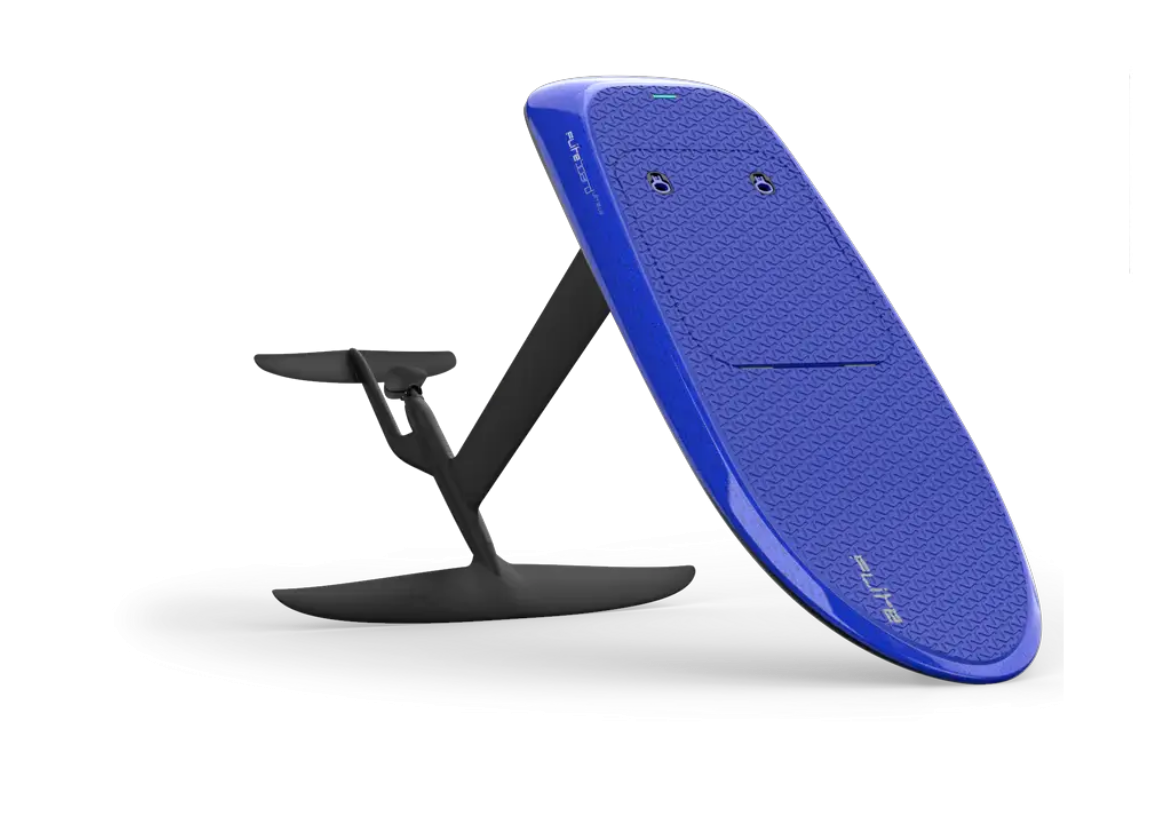
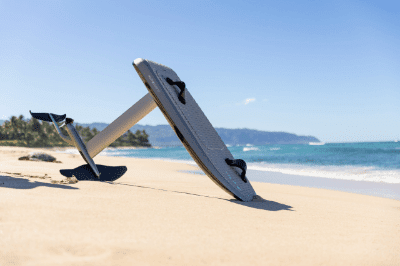
A FLUX setup is two parts, not one. The front wing does the lifting and carving. The stabilizer (the smaller rear wing) controls how the whole thing behaves: how stable it feels, how tight it turns, and how much drag it carries. Emerald Wake stocks three stabilizer sizes, 125, 140, and 160, and the one you pair with your front wing shapes the ride as much as the front wing itself.
The general rule is simple. Any stabilizer works with any front wing. A smaller stab gives you more agility and less drag. A larger stab gives you more stability and a bit more drag. So the stab is the dial you use to fine-tune the feel after you have chosen your front wing.
Here is how the three break down:
The 125 is the smallest and most agile. It is fast, loose, and low-drag, and it pairs best with the 707 for advanced riders who want the most responsive setup possible. Lighter riders on the 808 may also like it.
The 140 is the all-rounder. It balances the agility of the 125 against the stability of the 160, and it performs well across a wide range of conditions. For most Emerald Coast riders, the 140 is the safe, versatile choice.
The 160 is the most stable and the most forgiving. It carries a little more drag in exchange for a planted, predictable ride, and it helps when you are still dialing in control. It pairs best with the 1010, and it suits heavier riders and anyone who wants the calmest setup.
For the Gulf, two pairings cover most riders. An 808 front wing with a 140 stab is the balanced everyday setup: enough carve to be fun, enough stability to handle chop. A 1010 front wing with a 160 stab is the more planted, forgiving option for heavier riders or anyone who wants maximum stability under power. The tighter 707 with a 125 stab is the advanced carving setup, best left to riders with the skill and the conditions to use it.
You can add a FLUX stabilizer to your setup here. If you already own a stab and are not sure whether it suits the front wing you are eyeing, it is worth checking before you commit, since the pairing changes the ride more than most riders expect.
Does the FLUX system work with your existing Fliteboard eFoil?
This is the question that trips up the most buyers, so here is the clear answer. FLUX wings use the conical interface, the connection system Fliteboard moved to with the Series 5/6 lineup. That means they fit the current C-series eFoil propulsion systems: Prop C, Jet C, Flitescooter C, and the MN Carbon systems. If your eFoil has a "C" in the propulsion name, a FLUX wing will mount to it.
What they do not fit is the older flat-interface setups. If your Fliteboard uses a standard flat-mount wing rather than a conical one, a FLUX wing will not bolt on. There is no adapter that makes a flat-interface mast take a conical wing, so this is a hard compatibility line, not a workaround. For the full breakdown of which propulsion units are conical, with a compatibility table you can check your setup against, see our guide to the Fliteboard conical interface and wing compatibility.
The simplest way to check: look at your current wings and propulsion. If they are conical (C-series), you are set. If you bought your setup before the Series 5/6 conical changeover, the FLUX wings are not a drop-in upgrade for your board.
If you are not sure which interface you have, do not guess and order. Contact Emerald Wake and the team can confirm what your board takes before you spend anything. It is a two-minute check that saves a costly return.
Which FLUX wing works on flat Gulf days when there is no real swell?
If you ride out of Inlet Beach or the 30A inlets, you already know the pattern. Summer mornings are often glassy. There is no swell to speak of, just flat water and maybe a light afternoon chop once the sea breeze fills in. You are running your eFoil under power the whole time, and the question is which FLUX wing actually makes those flat days fun rather than flat in every sense.
On flat water, the wing's job is not to catch a wave. It is to carve well at the speed your motor is holding and to feel lively when you lay it over. The trap is going too small. A 707 on a glassy day gives you a tight, fast wing with nothing to push it, and you spend the session riding in a straight line wishing you had more to do.
The better call on flat Gulf days is a larger front wing that carves on a satisfying arc at cruising throttle and stays composed when the afternoon chop fills in. Going too small leaves you riding in a straight line with nothing to push the wing. The right size and stab pairing depends on your weight and how hard you like to lean into a turn, which is worth dialing in on the water rather than guessing from a spec sheet.
If you are upgrading from a standard Cruiser wing, expect the FLUX to feel more alive underfoot the moment you lean into it. The best way to find your flat-water setup is to ride one at an Emerald Wake demo before you commit, so you feel the difference on the water you actually ride.
What FLUX wing size should a bigger intermediate rider buy after a first demo?
Plenty of riders around Panama City Beach and Destin come to the FLUX wings the same way: they take a demo, get hooked, and then have to decide what to actually buy. If you are a heavier intermediate, somewhere in the 185 to 210 pound range, with a season or two of eFoil time behind you, the sizing math is a little different from what a lighter rider hears.
More weight means you want more lift and more stability under the board, especially in the open-water chop you get off PCB when the wind is up. The wing that punishes you least while you keep progressing is the bigger one.
Start with the 1010 and a 160 stab. It carries your weight comfortably at cruising throttle, it stays planted when the water gets bumpy, and it still carves enough to show you what the FLUX line is about. It is the setup that lets a bigger intermediate ride the way they want to ride now, not the way they hope to ride in two years.
The 808 is the wing to grow into, not the one to start with at this weight and skill level. Once the 1010 feels easy and you are carving harder and wanting quicker response, the 808 is the natural next step, and a lot of riders end up owning both. For a fuller picture of how board, battery, and wing choices work together at this weight, see our guide: Best eFoil Setup for Riders Over 200lb. There is no rush. Get the wing that is fun today.
Common questions about FLUX wings
Which FLUX wing is right for my weight and skill level?
As a starting point: heavier riders or anyone wanting maximum stability should look at the 1010; mid-weight intermediate to advanced riders wanting one do-everything wing should look at the 808; lighter, advanced riders chasing the tightest carve should look at the 707. Skill matters as much as weight. If you are still refining throttle and turn control, size up for stability.
Will FLUX wings work with my current Fliteboard eFoil setup?
Only if your eFoil uses the conical (C-series) interface: Prop C, Jet C, Flitescooter C, or the MN Carbon systems. FLUX wings do not fit older flat-interface masts, and there is no adapter. If you are unsure which interface you have, check with Emerald Wake before ordering.
Do I need to buy the stabilizer separately?
Yes. The FLUX front wing and the FLUX stabilizer are sold separately, so a complete FLUX setup is two purchases. The stab you choose changes the ride, so it is worth pairing it deliberately rather than reusing whatever you have on hand.
Which FLUX wing works best on the Gulf?
For most Emerald Coast riders, the 808 is the most versatile choice across flat-to-choppy days, and the 1010 is the pick for heavier riders or anyone wanting a more forgiving ride. The 707 is a specialist wing for advanced riders in the rare bigger, cleaner conditions.
What does AB stand for on the FLUX wings?
AB is the Adam Bennetts signature. Bennetts is a professional surfer and foiler who developed and tested the FLUX shapes, and the AB designation signals a surf-tuned wing built for carving and responsiveness rather than straight-line cruising.
Are more FLUX sizes coming?
FliteLab has indicated a wider range over time, including sizes above and below the current lineup. For now, the 707, 808, and 1010 front wings and the 125, 140, and 160 stabilizers are the sizes available, and they cover the great majority of riders and conditions.
Where can you try a FLUX wing before you buy?
A FLUX wing is a feel decision as much as a spec decision, and the best way to choose is to ride one. Emerald Wake runs demo days and a wing rental program for exactly this reason: so you can put a FLUX wing on the water, in real Gulf conditions, before you spend a thousand dollars on the wrong size. If you want to know how that works, here is our guide to testing Fliteboard wings before you buy.
If you already know your size, you can shop the front wing and stabilizer directly. If you are between sizes, unsure how your weight and riding line up, or not certain your eFoil takes the conical interface, the smarter move is a conversation first. Bring your weight, your board, and an honest read on how you ride, and the team can point you to the combination that fits.
Come ride a FLUX wing at an Emerald Wake demo, or get in touch to talk through the right setup for your eFoil and the water you ride. It is the difference between buying a wing and buying the right wing.
Ready to feel the FLUX difference on real Gulf water?
Ride one at a demo, or talk through the right front wing and stabilizer pairing before you buy.